
Overview
Computers for Schools Plus (CFS+)
ISED works with 14 Affiliates and multiple partner organizations to collect, refurbish and distribute donated computer equipment and electronic devices to schools, libraries, not-for-profit organizations, Indigenous peoples, and eligible low-income Canadians across the country.
The CFS Intern (CFSI) program
The program is delivered by CFS+ Affiliates and provides employment internships to youth (15 to 30 years old) in order to enhance their employability. CFSI is the in-house workforce for the CFS+ refurbishment workshops and is part of the Government of Canada's Youth Employment and Skills Strategy (YESS).
The combined budget for both programs during the evaluation period (April 1, 2016, and March 31, 2022) was $76.0 million, of which $70.3 million was Grants and Contributions (G&C) and $5.6 million was for operating expenditures (O&M).
The evaluation was conducted using multiple methodologies and sought to assess program relevance, performance and efficiency.
Findings
Relevance
The evaluation found that the CFS+ and CFSI programs remained relevant and in alignment with Government of Canada priorities and the Federal Sustainable Development Strategy. The COVID-19 pandemic increased the need for access to technology and highlighted gaps in access.
- Ongoing need for CFS+ to support Canadians in obtaining tools and skills to participate in the digital world.
- Ongoing need for CFSI program to support youth in developing skills and gaining experience to increase their employability.
- CFS+ and CFSI refurbishing electronic devices supports Government of Canada environmental priorities.
Performance
The CFS+ and CFSI programs met their performance objectives for the period under evaluation. The programs contributed to Canadians' accessibility to computer technology and reduced the environmental footprint associated with surplus electronic equipment. CFSI, through CFS+ contributed to learning opportunities for youth of diverse backgrounds to develop skills for future employment.
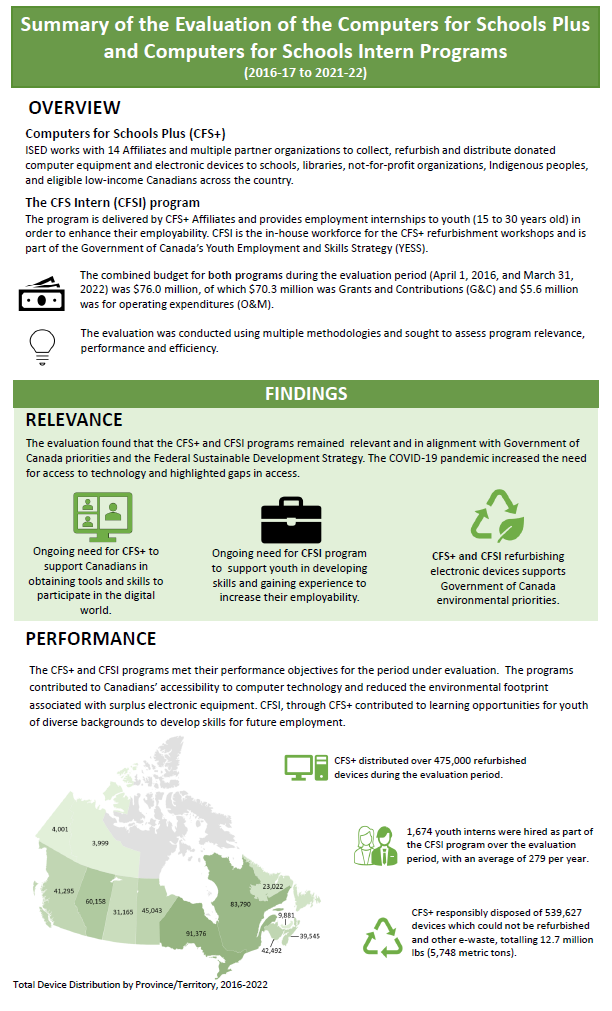
Total Device Distribution by Province/Territory, 2016-2022

Highlights:
- CFS+ distributed over 475,000 refurbished devices during the evaluation period.
- 1,674 youth interns were hired as part of the CFSI program over the evaluation period, with an average of 279 per year.
- CFS+ responsibly disposed of 539,627 devices which could not be refurbished and other e-waste, totalling 12.7 million lbs (5,748 metric tons).
Skills obtained by youth interns:
Digital skills
- Hardware repair & refurbishment (96%)
- Data management (48%)
- Development of communication strategies (29%)
Career skills
- Interpersonal and teamwork (92%)
- Problem solving (86%)
- Organizational (82%)
Source: CFSI Evaluation Survey
| CFS+ | CFSI | Outcomes |
|---|---|---|
| yes | yes | Effective in reducing the environmental footprint of surplus equipment |
| yes | n/a | Developed a large network of partners to increase reach of the program and ensure success |
| yes | n/a | Computer recipients were satisfied with the CFS+ Program |
| yes | n/a | CFS+ was leveraged to deliver on other priority programs such as Connecting Families Initiative. |
| yes | yes | Effective in increasing access for Canadians to computer technology. |
| yes | yes | Provided learning opportunities and enhanced employability for diverse youth |
| n/a | yes | Interns developed digital skills and secure employment in a technology field |
| n/a | yes | Interns expressed high satisfaction with the CFSI program. |
Challenges:
- Inconsistencies and gaps in data reporting were observed during the evaluation when assessing donor contributions, organization types, and the socio-economic breakdown of device distributions.
- Affiliates noted challenges to operational efficiencies specific to their regions and opportunities to leverage partnerships were identified.
Efficiency
The evaluation found that the CFS+ and the CFSI were delivered efficiently with delivery models across the country varying according to regional needs. The efficiency of the CFSI and CFS+ programs allowed the Connecting Families Initiative to also successfully distribute devices. Both ISED and the CFS+ Affiliates implemented measures to improve the operational efficiency of the program.
ISED efficiency measures:
- Multi-year contribution agreements
- Streamlined reporting templates
- Online marketplace (to facilitate transfer of equipment between Affiliates)
- Financial outlook forecast exercise
Affiliate efficiency measures:
- Cost recovery on some devices
- Online inventory management
- Cloud based bookkeeping
- Contract accounting
- Lean Sigma Implementation
Recommendations
- ISED Connected Canada Branch should implement approaches to enhance the consistency of data submitted by CFS+ Affiliates. The availability of consistent and complete data for CFS+ in the areas of donor types, contributions and device distribution by socioeconomic group would ensure progress against CFS+ expected outcomes and position the program to continue responding to the evolving technology needs of Canadians.
- ISED Connected Canada Branch should investigate further opportunities to increase donor contributions and partnerships to meet program needs, expand the reach of the CFS+ program and support operational efficiencies for CFS+ Affiliates.